Showing posts with label backpacking. Show all posts

Wednesday, August 29, 2018

Walking Tour of Budapest 1

Exploring Budapest

Points of Interest by Foot

Hungarian Parliament Building

Hungarian Parliament Building
The third largest parliament building in the world - the Hungarian Parliament Building is the seat of national assembly of Hungary. This impressive Neo-Gothic structure is also the symbol of Hungary and its capital city. Apart from being the building of Hungary's law-making body, it also houses the Hungarian Holy Crown, and the offices of the Prime Minister.

Facade
Adult admission fee is HUF 2400 (EU citizens).

Kossuth Square

Part of Kossuth Square
Considered as the main square of the nation - Kossuth Square was just recently reconstructed into a rational and sustainable park structure. The park is a no-traffic zone and there are still on-going plans on further developing the park.

Lion Fountain

Sitting in Vörösmaty Square, the Lion Fountain is considered among the most beautiful fountains in the city. It's a popular meeting point of several walking tours as it is conveniently located in one of the busiest hubs in downtown Budapest. The Vörösmaty Square is the start of the city's famous shopping street, Váci Utca.

The Lion FountainSt.

Stephen's Cathedral

St. Stephen's Cathedral is a Roman Catholic basilica named in honour of the first king of Hungary whose mummified right hand, the Szent Jobb ("the holy right hand") is housed in the reliquary.


St. Stephen's Cathedral
Going up to the cupola is a good way to see beautiful panoramic views of the city, while the St. Stephen's square offers plenty of terraced cafes and bistros that are perfect for people watching.

Admission into the basilica is free but it is customary to give HUF 200 or €1 donation. A separate ticket is needed to go up to the cupola.

Apart from Catholic services, the cathedral also organises organ concerts.

Little Princess statue


Little Princess Statue
Kiskirálylány - a small statue of a princess sitting on the railings of the Danube promenade. The original statute was created by an artist, László Marton, inspired by his eldest daughter born from his first marriage. It is one of Budapest's secret gems.

Chain Bridge

Chain Bridge
The Széchenyi Chain Bridge is a suspension bridge spanning the Danube River and linking Buda and Pest. Stretching between the Széchenyi Square on the Pest side to the Clark Ádám Square on the Buda side, this picturesque bridge symbolises the unification of what used to be divided sides of the Danube River into one city. It is the first bridge built to connect Buda and Pest.

Enjoy stunning views of the city from both ends of the bridge and while crossing it. It is also worth crossing at night when the bridge is lit up.

Castle Hill

Sitting on top of a hill on the Buda side, the Castle Hill is a walled complex bounded on the north by the Castle District which comprises the entire walled area of the hill. What used to be a bustling capital of Buda, the complex is the location for key attractions such as the Buda Castle (which now houses the Hungarian National Gallery and Budapest History Museum), the Fisherman's Bastion, and St. Matthias Church.
Buda Castle Hill Funicular
Get there either by riding the Buda Castle Hill Funicular (HUF 1,100 one way or 1,700 return) or taking the short hike up by the side of the hill.

Entrance to Buda Castle
Buda Castle is the historical castle and palace complex of the Hungarian kings.
Buda Castle Ruins
Buda Castle
The 700-year old Matthias Church is now a Roman Catholic church atop Buda Hill. It used to be the venue for coronations and royal weddings and was founded by the first king of Hungary, Szent Stephen. Marvel at its exterior with its delicate turrets and coloured tiled roof with welcoming combinations of warm lights, shadows and colours of orange, brown, and gold.

St. Matthias Church
Back of St. Matthias Church
Statue of St. Stephen and Matthias Church
The Fisherman's Bastion is the fairytale-like neo-Gothic and neo-Romanesque style viewing terrace sitting on the edge of Buda Hill, overlooking the Danube and offering panoramic views of Budapest.

Panoramic views of Danube River and Pest from Fisherman's Bastion
Walk around the Old Town and explore its quaint streets.

Holy Trinity Statue
Grab some lunch at Piknik Pavilon, and try out the famous 7-layer Hungarian cake, Dobos torte at Ruszwurm Confectionery - the oldest family-run cafe in Budapest with a 200-year legacy.

Piknik Pavilon
Lunch: pork knuckles with potatoes and coleslaw, and spicy Hungarian sausage in a bun

Dobos torte
After exploring the old town, head back to the lookout in Buda Castle at golden hour to witness the beauty of Budapest as dusk approaches and darkness envelopes the city. And have another fine and relaxed stroll down the hill back to Pest.

View of Chain Bridge from Buda Castle lookout
Chain Bridge at night
View of Castle Hill from Pest side at night
Have dinner in Street Food Karaván - a collection of kiosks serving great-tasting food in Kazinczy Street.
Karaván
Experience a unique night out with good booze and eccentric decors at one of the city's largest and most famous ruin pubs, Szimpla Kert. Make sure to have at least one shot of Unicum - a herbal digestive liquor made up of about 40 different herbs, and the Palinka - a fruit brandy.

Szimpla Kert
And finally, end the night with a crazy Pub Crawl and have fun exploring different ruin pubs across the city with great company.

Pub Crawl


Expenses:
Lunch = 2950
Cake = 320
Dinner = 850
Szimpla Kert = 1450
Pubcrawl = 3000

TOTAL: HUF 8,570

Tuesday, August 7, 2018

A Gastronomic Experience from Cambodia to Vietnam

A photo diary of the different food we've tasted and encountered during our Cambodia - Vietnam trip.

Pubstreet, Siem Reap, Cambodia
A different kind of BBQ night

Insects, anyone?
In Cambodia, it is common to see among their staple street food your crawling nightmares - insects! Usually, these insects are fried and include black beetles, huge hairy spiders, crispy locusts, and crickets among many others, served with dried herbs and or hot chili peppers.

Khmer Kebab

Khmer Burger and fries

Banana Mango, Hue, Vietnam
Vietnamese Bangus Belly

Vietnamese Spaghetti

Pho Tai, Bo Vien
Pho Tai, Bo Vien is a pho soup with sliced beef tender and meat balls, garnished with different herbs such as basil leaves, etc. It can also be served in a spicy soup.
Holiday Diamond Hotel, Hue, Vietnam
Breakfast All You Can

Fruits, bread, coffee
Hoi An, Vietnam
White Rose Dumplings
White Rose Dumplings were named as such by the French. This dish is famous among tourists because they are not just beautifully presented, but are very good to the taste buds! It is made from white rice flour, and stuffed with cooked shrimp meat. The translucent color of the flour blending with the color of the stuffing makes it look like a white rose petal.

Cau Lao
Cau Lao is a famous dry noodle dish in Hoi An. Basically, this dish is just made up of pork, noodles and green leafy vegetables. The unique taste of the dish was said to be due to the use of the water which is derived from an ancient Cham well found somewhere in this town.

Gelato ice Cream

BBQ ala-Hoi An

Hoi An BBQ
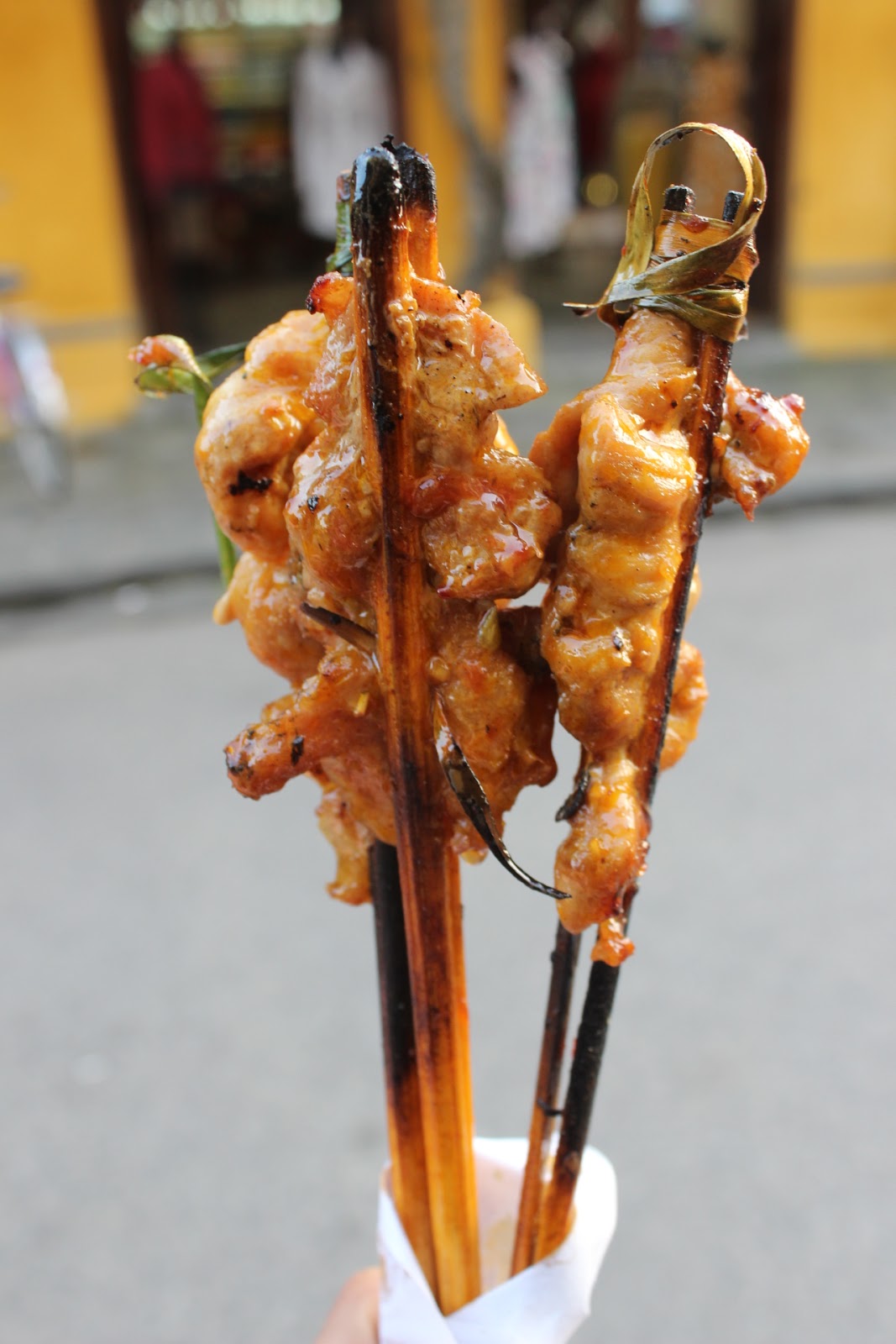
Inside the walking and cycling city of Hoi An, you can see food street vendors squatting along the sidewalks at the corners of streets or certain establishments. Indeed, the smell and the appearance of these BBQ sticks would make your mouth water. Fortunately, they do not disappoint because they are not just cheap but taste so good as well!

Thursday, February 26, 2015

Travel Essentials for Backpacking Asia

A wise traveler would know that he has to do research about each destination before hand. This is so he can plan, or actually, just 'draft' an itinerary, and also to prepare the necessary things such as clothing and or special requirements that each place holds. Backpacking Asia is relatively easier to do than backpacking other continents. This is because when you backpack tropical countries, you can really 'pack lightly'. And I cannot stress this enough: you cannot over pack clothes when backpacking Asia. So for every backpacker planning to go through Asia's wonders, here's my quick checklist for travel essentials when backpacking Asia (in no particular order).

> Medicine Kit
Specially for people with asthma and or allergies, a medicine kit is a must. It does not have to be huge or numerous, but just includes remedies for usual stuff that people (or you) go through or experience when traveling, such as pain killers, antacids, anti-histamine, anti-motion sickness, medicines for fever or flu and common colds and cough. It is always better to be ready than sorry.

> Toiletries
If you're looking at budget traveling/backpacking, most hostels and or dormitories don't have free toiletries. So better have yours ready. I recommend buying toiletries in the form of sachets for one time use only so that you can dispose of the pack immediately and it doesn't have to spill its contents inside your pouch or bag. I also prefer liquid soap over bar soap, but just make sure it is not more than 100 mL if you did not buy a check-in luggage. Or you could put one bar of soap inside a zip lock container. My toiletries usually include toothbrush, sachets of shampoo and conditioner, toothpaste, moisturizer/lotion, facial and feminine wash, and deodorant.

> Mosquito Repellent
We're in Asia; in most countries, malaria has been extinguished, but in others, this is not particularly true. So just in case, I always bring one bottle of mosquito repellent lotion. Or you can have an anti-malaria vaccine before your trip. An ounce of prevention is better than a pound of cure!

> Water bottle
You're a traveler in a tropical continent, dehydration is a no-no. So, better be ready with a water bottle so that you may refill this container instead of just buying and buying bottled mineral water all the time. Just make sure that the source is clean, though, to prevent your trip being spoiled by frequent trips to the water closet.

> Camera
Just because you're a backpacker who wants to be distinguished from a tourist, doesn't mean that you can't be seen with a camera. Bring your trusted DSLR or SLR, or just your smartphone and get your poses ready! Because Asia's got its wonders for you.

> Gadgets and Chargers/Powerbank
Of course, this should be next to the list after mentioning the camera. It's okay to bring gadgets, just don't forget to bring along their chargers, and or a powerbank for emergency purposes. You may also want to have a back-up battery for your camera.

> Towels
I always travel with a sports towel which also doubles as a body towel. I recommend you buy those towels with features like quick-absorbent and quick-dry, especially if you're a traveler who's always on the go. This is because, compared to ordinary towels, these babies can absorb water fast but also need less time to dry. This is one travel essential for budget travelers booking accommodations that don't provide fresh towels.

> Undergarments 
You can buy disposable lower body undies or, to save money, just pack more or less half the total number of days of your trip and just be ready to wash and recycle undies for long term trips. For girls, you may do the same trick for brassieres.

> Sarong/Scarf/Malong 
When traversing tropical countries, I'm sure you're gonna use different forms of transportation. And in such hot and humid countries, the air-conditioning of such transport systems are usually insanely inhumanely cold. So having a sarong/scarf/malong or other cover-ups like cardigans or sweaters are very much an essential travel buddy. They can also be helpful in lots of tourist destinations in Asia with strict attire policies, especially for the ladies. It can also serve you well while on the beach or when you'd like to sit or lie down by covering the ground.

> Eco Bag
These babies will be very useful for containing stuff you've hoarded all throughout your backpacking journey. The cloth-like eco bags can also serve as a kind of separator/organizer inside your gargantuan backpack. If you're going shopping, this is a good travel buddy to have so that you don't need to carry around loads of plastic bags, etc. They can also serve as your dirty clothes bin.

> Clothes
Shorts, leggings, and pants are good for traveling in Asia. No need for layers of clothes. Spaghetti straps, sleeveless, tank tops or even cropped tops are welcome. The sarong/scarf/malong would do the saving when necessary to hide some skin. But all in all, just make sure that you're comfortable with the fabric, since most countries in Asia are hot and humid. Fabrics that are breathy and light should be your choice. The number of tops I bring are around more than half of the days that I'd be traveling, and then I always have a pair of jeans, some shorts, and at least 2 leggings.

> Shoes/Slippers/Foot wear
No special requirement for foot wear. Your trusted Nike rubber shoes, or even just comfy flats/sandals that can also double as slippers, are advisable for touring around hot and humid countries. Just make sure that you're comfortable with your footwear as it will make or break your ability to walk around the marvels of Asia. I always bring at least 2 footwear: my Nike Roshe for days with long walking required, and a pair of Havaianas as my slippers or footwear which can also get wet if necessary.

> Money
A lot of countries here in Asia would require you to use their currency, but having some USDs in your pocket is a travel essential. Most countries would accept payments in USD and then they'd just give you change in their currency. But, the extra USDs should be for emergency purposes only.

Hope this checklist helps! Ciao!

Sunday, February 15, 2015

Exploring Kampuchea

DAY 1: Siem Reap Night Life
Siem Reap International Airport
Our flight for Siem Reap was actually one miracle. It's because it nearly got cancelled because of the arrival of Pope Francis in the Philippines; there were too many delayed flights because the terminals were trying to accommodate the rescheduled flights cancelled due to the Pontiff's arrival. So, yeah, you could say it was a miracle this flight didn't get delayed or such.
Pubstreet Street Food
Insects and Meat
We touched down at Siem Reap International Airport at around 930 pm. My first impression of a country sometimes depend on the things I see through the windows of the plane. And compared to the usual scenic views one might see when arriving at night at a city, what I saw was darkness. Sure, there were some areas with flicks of lights, but they don't even equate to the lights of one barangay in the Philippines. Siem Reap, thus, gave me the idea that I was in a remote province of the Philippines. And this was actually confirmed when we took a 13-dollar taxi for 6 pax towards our hostel. The airport taxi has a kiosk at the exit of arrivals area and the staff are fluent in the English language and are very friendly as well. To save some bucks, our group of four joined a pair to rent a big taxi, instead of renting a small taxi worth 10 dollars.

Khmer Kebab
Khmer Burger and fries
Almost all of the establishments were already closed. And there isn't much activity going on even at the airport. We booked one night at Tanei Guesthouse for only 10 USD/person/night. This charming guesthouse is just walking distance from the nightlife of Siem Reap, both night markets and restaurants/bars. So after settling down, we walked towards Pubstreet for dinner and to have a glimpse of their night life.

Dinner Place
After dinner, we walked around to explore Pubstreet, but during this time, almost all of the establishments were starting to close. There were some bars with rooftop seating with live band performing throughout the night, while other restaurants were good for just chill dinner. The streets are lined with kiosks selling fruit shakes, or some street food. There isn't much to do anymore but to go back to the hotel and retire for the night.

Siem Reap Night Market

Costs of the day:
> Taxi for 6 pax (2 stops): 13 USD/6 = ~2 USD
> Dinner: 8 USD/2 = ~4 USD
> Guesthouse (1D1N): 40 USD/4 = 10 USD
Total = ~16 USD
 

Template by Best Web Hosting